Voltly
Field calcs you'd wire to — code cited, all offline.
Code-true electrical answers on any job — voltage drop, ampacity, conduit fill, box fill, bending — each citing the NEC article, 100% offline.
Voltly offers an auto-renewing subscription. Payment is charged to your App Store or Google Play account; it renews automatically unless cancelled at least 24 hours before the period ends, and you can manage or cancel anytime in your account settings. Terms and Privacy Policy.
Voltly
productivity
Field calcs you'd wire to — code cited, all offline
Account
Not required
Analytics
Opt-in & anonymous
Your data
Stays on device
Ads & trackers
Zero
What you get
Built for exactly this — and nothing you don't need.
Stop second-guessing your numbers
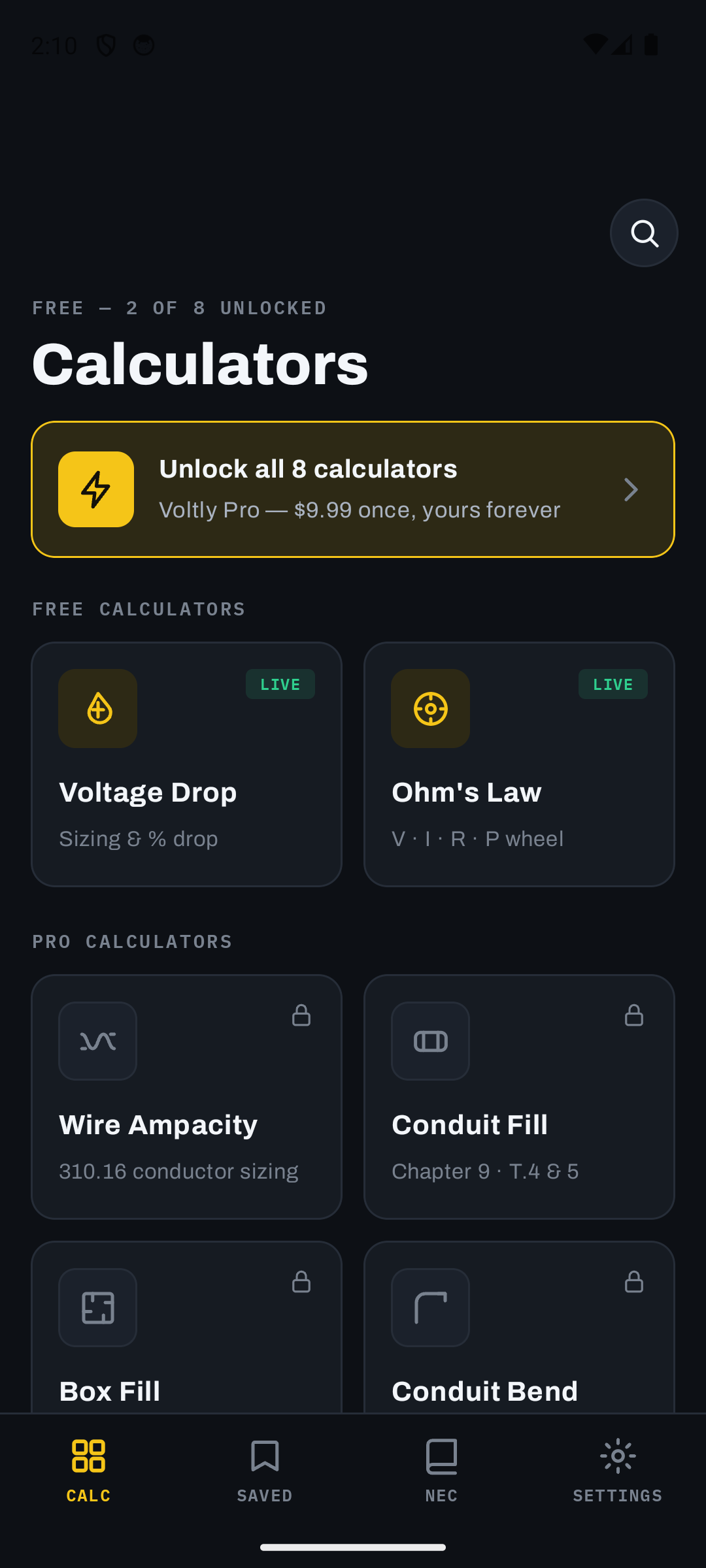
eight field calculators on one glove-friendly hub: Voltage Drop, Wire Ampacity, Conduit Fill, Box Fill, Conduit Bending, Motor FLC, a converter suite and Ohm's Law. Voltage Drop and Ohm's Law are free; the rest unlock with Pro.
Wire to the number with confidence
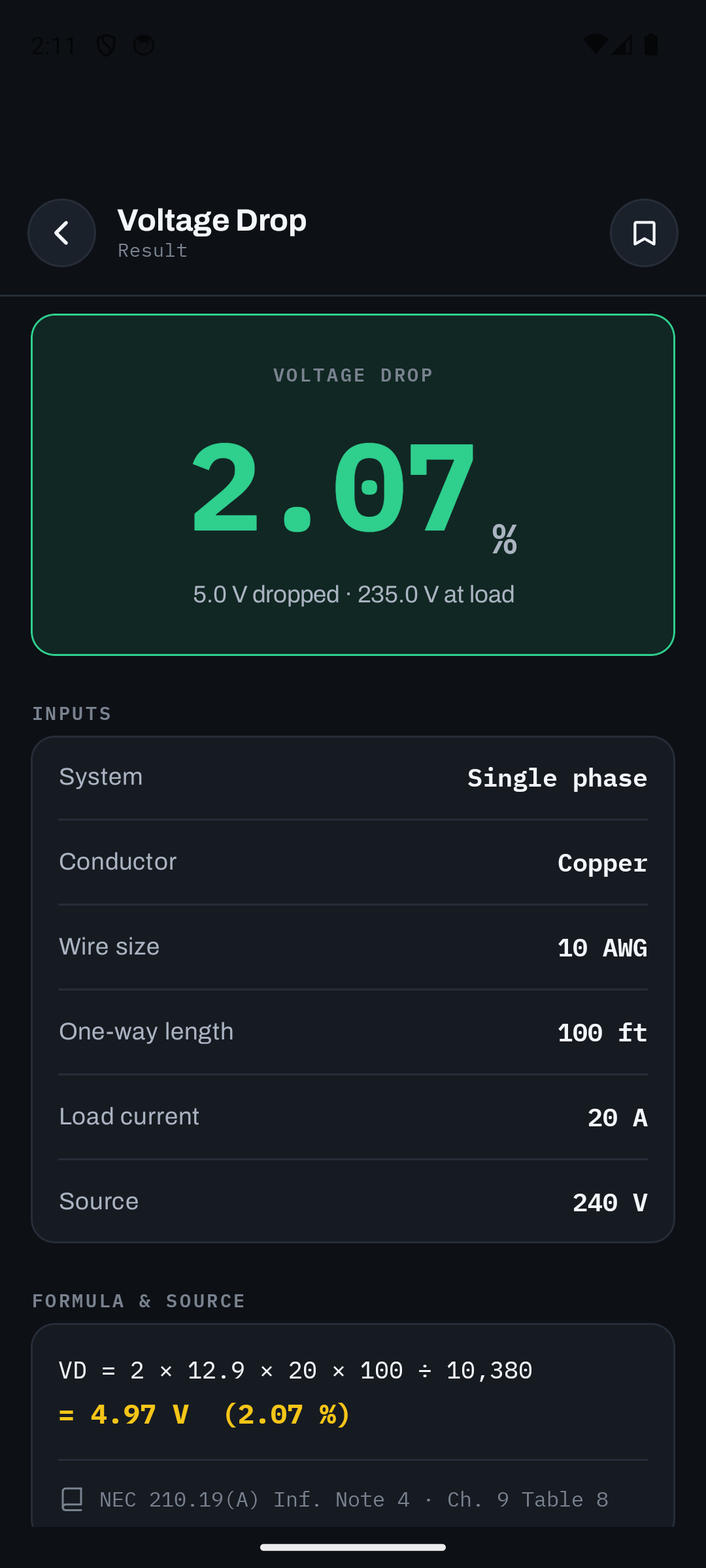
every result names the NEC article behind it (Table 310.16 ampacity, 314.16 box fill, Chapter 9 conduit fill), so you can defend the answer to any inspector.
Size conductors right the first time
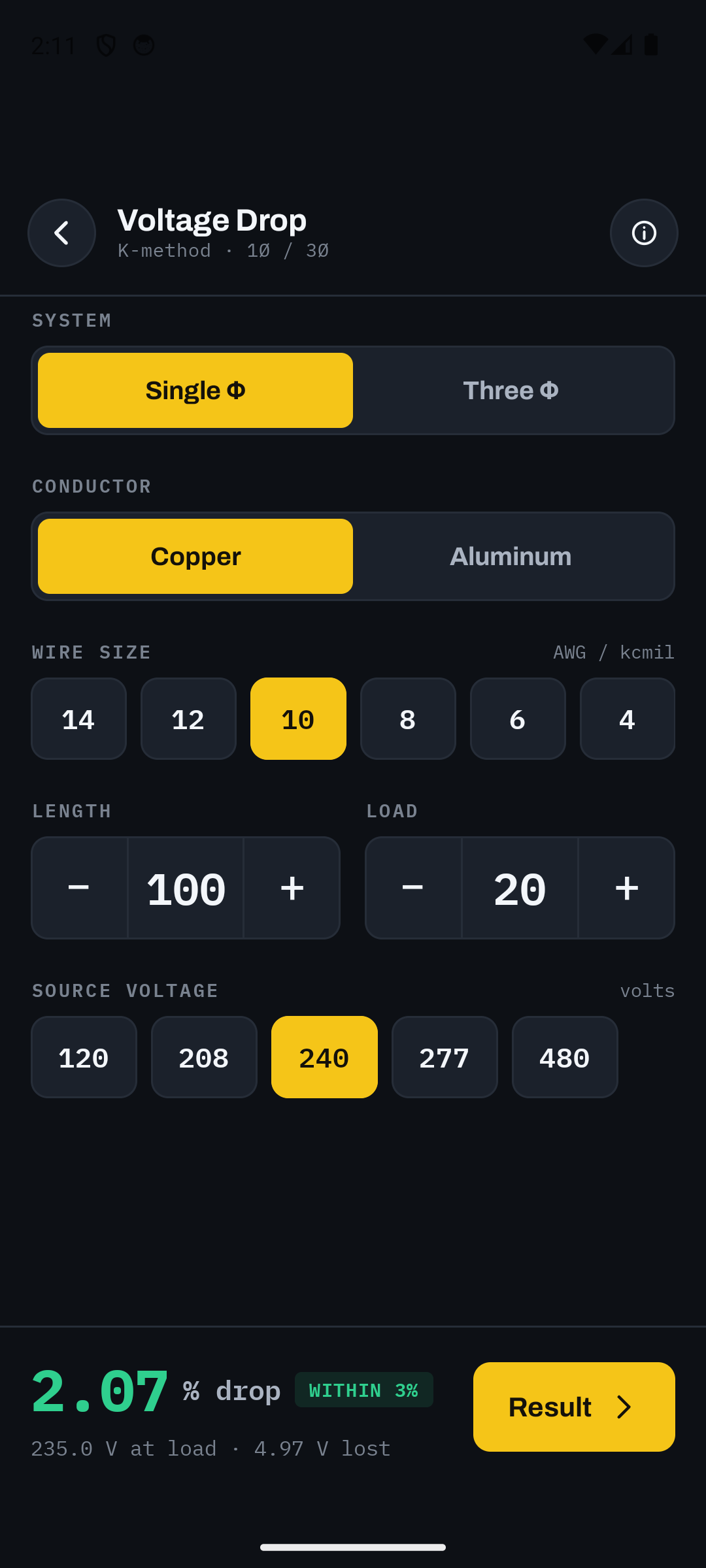
Voltage Drop runs 1Ø/3Ø in copper or aluminum, flags anything over the 3% recommendation and suggests the upsize; Wire Ampacity uses Table 310.16 with selectable 60/75/90°C termination columns and derate factors.
Bend it once
offset, three-point saddle and 90° stub math hand you the marks before you reach for the bender, so you stop scrapping conduit.
Skip the conversion math
Motor FLC returns full-load amps with 125% conductor and OCPD sizing, plus a converter suite for units, AWG↔mm² and kVA.
Look up code with zero bars
an offline NEC reference of the tables and articles electricians check daily, in plain language with the article number cited; works in basements, panel rooms and steel buildings with no signal and no account.
Never lose a calc
save results into jobs organized by site, panel or circuit in an on-device store; the free tier keeps your last 5, Voltly Pro is unlimited.
Hand off clean paperwork
export any result as a labeled PDF job sheet and turn on iCloud sync (both Pro); tune theme, accent, imperial/metric units and NEC edition (2020 / 2023 / 2026) in settings.
A look inside
See it in your hands.

How it works
Up and running in under two minutes.
- 01
Open the calculator hub and pick a tool — the two free calcs open directly; tapping a locked Pro calc routes to the paywall.
- 02
Enter the job with segmented controls, size pills and steppers — no fiddly keyboard — and the result updates live.
- 03
Read the authoritative readout with its status, the formula used, and the NEC article it derives from.
- 04
Save the result to a job (organized by site/panel/circuit) or look it up later in the offline NEC reference — everything stays on the device, no account needed.
A note from the studio
“Electricians work gloved, in bad light, in dead zones — and still pay for a drawer of dated, single-trick apps to get one number. I wanted a single instrument that's fast, fully offline, and cites the code on every result, so you can wire to the answer and prove it to the inspector. That's all Voltly is: the whole drawer, done right, in one app.”
Questions
The honest answers.
Is Voltly free?
Yes — the Voltage Drop and Ohm's Law calculators, the free-tier NEC reference entries and your last 5 saved calcs are free forever, with no account. Voltly Pro unlocks the other six calculators and unlimited saved jobs.
Is it a subscription or a one-time purchase?
Voltly Pro is a one-time $9.99 Lifetime unlock — pay once, yours forever. If you'd rather subscribe, there's an optional annual plan ($49.99/yr) or monthly ($6.99/mo), both with a 7-day free trial. No subscription is required to own Pro.
Does Voltly work offline?
Completely. Every calculator, table and code reference lives on your phone, so it works in basements, mechanical rooms and dead zones — no signal, no login, no waiting.
Can I trust the numbers?
Voltly uses commonly-published NEC values and shows the formula and the cited article on every result, so the answer is always traceable. It's a field aid — always verify safety-critical results against the currently adopted NEC and your local amendments.
Do you collect my data or show ads?
Never. No ads, no data sale, no account or sign-in. Your jobs and calculations stay in an on-device store; anonymous analytics and crash reports are both opt-in and off by default.
What platforms does Voltly run on?
Voltly is on the App Store for iPhone, built natively for the job site. An Android build runs on the same calculation engine and code reference.
How is it different from Ugly's or Electrical Calc Elite?
Most tools give you live calculators or static code tables — Voltly bundles both in one fast, modern app: working calculators with the NEC article cited on every result, fully offline, for a single $9.99 unlock.
What does Voltly Pro unlock?
All eight calculators (Wire Ampacity, Conduit Fill, Box Fill, Conduit Bending, Motor FLC and the converter suite on top of the free pair), unlimited saved jobs, labeled PDF job-sheet export, iCloud sync and the full offline NEC reference.
Launching soon
Be first to know when Voltly ships.
It'll launch at $9.99. Free tier: voltage drop and ohm's law calculators, free-tier nec entries, and the last 5 saved calcs — no account, fully offline..
One email when it lands on the store. No drip sequence, no spam.
No spam. No tracking. Email only — unsubscribe with one click.
Your saved calculations, jobs and preferences are stored locally on your device (an on-device SQLite database plus app preferences). There is no server copy.
From the journal
Notes on the practice.
- 01
Why Is One Plug Blade Wider? The Polarized Plug and the Lamp Socket Where It Matters Most
Why is one plug blade wider than the other? A polarized plug decides which wire touches the bulb's metal threads. Here's the rule, and how to replace a lamp cord right.
2026-11-16
6 min read
- 02
EMT Conduit Support Spacing: Why NEC 358.30 Puts a Strap Within 3 Feet of Every Box
EMT conduit support spacing under NEC 358.30 means a strap every 10 feet and one within 3 feet of each box. Here is the beam physics that makes the 3-foot rule matter.
2026-11-16
7 min read
- 03
Type S Fuse vs. Edison Base Fuse: Why a Penny Behind the Fuse Is the Most Dangerous Repair in Your Basement
Type S fuse vs. Edison base fuse: why old fuse boxes let anyone swap in a bigger fuse, how the rejection base stopped it, and what to check if you still have one.
2026-11-15
7 min read
- 04
Voltage Drop and Motor Torque: Why a 10% Sag Costs a Motor 19% of Its Pull
Voltage drop and motor torque are tied by a square: a 10% sag steals 19% of a motor's pull. See why long runs stall at startup and how to check yours today.
2026-11-14
7 min read
- 05
Can EMT Conduit Be Used as a Ground Wire? Why the Pipe Counts, and When It Quietly Doesn't
Can EMT conduit be used as a ground wire? Yes, under NEC 250.118, but only if every joint stays tight. Here's the fault-current physics behind that rule.
2026-11-14
6 min read
- 06
Why Switch the Hot Wire, Not the Neutral? The Rule Behind Every Light Switch and Breaker
Why switch the hot wire and not the neutral? The wiring rule behind every switch and breaker, and what happens to a 'dead' fixture when someone gets it backward.
2026-11-13
7 min read
- 07
Why Is the Ground Pin Longer on a Plug? The Part That Connects First and Lets Go Last
Why is the ground pin longer on a plug? It's built to connect first and disconnect last. Here's the safety logic, and what to do when a pin is missing or loose.
2026-11-13
6 min read
- 08
Why Does My Kitchen Breaker Keep Tripping? The Two 20-Amp Small Appliance Circuits NEC 210.11(C)(1) Requires
Why does your kitchen breaker keep tripping? The NEC requires two 20-amp small appliance circuits for a reason. The math of toaster plus kettle shows how to stop it.
2026-11-13
7 min read
- 09
Pigtailing Outlets vs. Daisy-Chaining Them: Why One Failing Receptacle Can Take Down Everything Downstream
Pigtail vs daisy chain outlets: why wiring through a receptacle's terminals makes it a single point of failure, what the NEC does and doesn't require, and when to pigtail.
2026-11-12
7 min read
- 10
Electrical Wire Color Code: What the NEC Actually Requires (and Why Most Colors Are Only a Habit)
The electrical wire color code is mostly convention, not law. Learn the few colors the NEC truly mandates, which ones are habit, and how to stop trusting insulation.
2026-11-12
7 min read
- 11
Why Breaker Panels Alternate Phases: The Hidden Pattern Behind Every Slot
Why breaker panels alternate phases: the zigzag bus bars inside your panel decide which circuits share load, which make 240 volts, and why a neutral stays calm.
2026-11-11
7 min read
- 12
What Does the 600 Volt Rating on Wire Mean? It Isn't About Current or Your Safety Margin
What does the 600 volt rating on wire mean? It describes insulation, not current. Learn what it guarantees, what it ignores, and why it can mislead you.
2026-11-11
7 min read
- 13
Why Ream EMT Conduit? The Invisible Burr Inside a Fresh Cut That Strips Wire Insulation
Why ream EMT conduit after cutting it? The burr inside a fresh cut is a blade waiting for your wire. Here is what NEC 358.28 is protecting you from.
2026-11-10
7 min read
- 14
No Neutral in Your Switch Box? What NEC 404.2(C) Requires and Why Smart Switches Need It
No neutral in your switch box? Learn why old wiring skipped it, what NEC 404.2(C) now requires, and how smart switches quietly lean on that missing white wire.
2026-11-10
7 min read
- 15
Dimmer Switch Derating: Why Ganging Dimmers in One Box Lowers Their Wattage Rating
Dimmer switch derating explained: why a 600-watt dimmer can safely carry less once it shares a box, where the heat comes from, and how to size the load before you wire.
2026-11-10
7 min read
- 16
Why Power Lines Run at Hundreds of Thousands of Volts: The I²R Math Behind High-Voltage Transmission
Why do power lines use such high voltage? The same wire loses a million times less energy at 1,000× the voltage. Here's the I²R math, and what it means on your next long run.
2026-11-09
7 min read
- 17
High-Leg Delta Orange Wire: Why One Phase Reads 208 Volts to Neutral When the Other Two Read 120
High-leg delta explained: why the orange wire reads about 208 volts to neutral while its neighbors read 120, and why landing a 120-volt load on it can wreck equipment.
2026-11-09
7 min read
- 18
Why Is US Household Voltage 120 Volts? How a Light Bulb Decision from 1882 Still Lives in Your Walls
Why is US household voltage 120 volts and not 240? The answer starts with Edison's lamps and ends in the wire in your walls. Here is what the number costs you today.
2026-11-08
7 min read
- 19
Why Is 14 AWG Wire Limited to a 15-Amp Breaker When the Ampacity Table Says 25? NEC 240.4(D) Explained
14 AWG copper is listed at 25 amps in the NEC table, yet code caps it at a 15-amp breaker. Here is what NEC 240.4(D) is doing and why the smaller number wins.
2026-11-08
7 min read
- 20
Wire Nut Size Chart: Why the Color on the Cap Is About Wire Volume, Not Wire Gauge
A wire nut size chart looks like a color code, but the cap is really a spring sized for a volume of copper. Here is why the wrong one passes the tug test and fails later.
2026-11-07
7 min read
- 21
Why Do Transformers Hum? The 120 Hz Sound of Steel Changing Shape
Why do transformers hum? It isn't a defect. It's the iron core physically changing shape 120 times a second. Learn which hums are normal and which mean trouble.
2026-11-07
7 min read
- 22
Why Do Light Bulbs Burn Out When You Turn Them On? The Cold-Filament Surge Behind the Pop
Why do light bulbs burn out when you turn them on? A cold tungsten filament draws a surge many times its running current. Here's the physics, and what it means for switches.
2026-11-06
7 min read
- 23
Outlet Orientation: Ground Pin Up or Down, and Why the NEC Never Settled It
Ground pin up or down on an outlet? The NEC doesn't say, but a half-pulled plug and a falling metal object explain why the argument is worth having.
2026-11-06
6 min read
- 24
Romex Minimum Bend Radius: Why NEC 334.24 Limits How Sharply You Can Fold Cable
Romex minimum bend radius is five times the cable's diameter under NEC 334.24. Here's the geometry behind it, and why a tight fold hides damage you can't see.
2026-11-05
7 min read
- 25
Lockout Tagout Explained: Why Your Own Padlock Is the Only Switch You Can Trust
Lockout tagout explained: why a padlock with your name on it beats a warning tag, a phone call, or a coworker's promise when the circuit you're working on can be re-energized.
2026-11-05
7 min read
- 26
Do Surge Protectors Wear Out? Why the Green Light on Your Power Strip Can Keep Glowing After the Protection Is Gone
Do surge protectors wear out? Yes. The part that saves your electronics is sacrificial, and the light on the strip may not tell you when it's spent. Here's how to check.
2026-11-05
7 min read
- 27
Which Direction to Wrap Wire Around a Screw Terminal: Why the Hook Must Follow the Screw
Which direction to wrap wire around a screw terminal? Clockwise. A counterclockwise hook pushes itself loose as you tighten it, and the friction behind that is simple.
2026-11-04
6 min read
- 28
Pull Box Sizing Rules: Why NEC 314.28 Wants a Box Eight Times the Conduit Diameter
Pull box sizing rules in NEC 314.28 look arbitrary until you picture stiff wire turning a corner. Learn the 8x and 6x formulas, with worked examples you can use today.
2026-11-04
7 min read
- 29
Nicked Copper Wire: Why a Scratch From Your Strippers Can Break a Conductor Years Later
A nicked wire conductor rarely fails the day you make it. Learn why a tiny stripper scratch turns into a fatigue crack, a hot connection, and a callback, and how to prevent it.
2026-11-04
6 min read
- 30
Why Birds Can Sit on Power Lines Without Being Shocked (and the Two-Point Rule Behind It)
Why birds can sit on power lines without being shocked has nothing to do with insulation. The real reason explains how every electrical injury actually happens.
2026-11-03
7 min read
- 31
Knob and Tube Wiring and Attic Insulation: Why Old Wires Were Built to Breathe
Knob and tube wiring insulation is a quiet fire risk: these old wires shed heat into open air, and a blanket of attic insulation takes that escape route away.
2026-11-03
6 min read
- 32
How a 3-Way Switch Works: Why the Lever Position Never Tells You If the Light Is On
How a 3-way switch works: your staircase light is a tiny logic circuit with no 'on' position, and understanding it makes every wiring mistake obvious.
2026-11-02
7 min read
- 33
3-Wire vs 4-Wire Dryer Cord: Why the Fourth Prong Exists and What the Metal Case Does Without It
3-wire vs 4-wire dryer cord explained: why a loose neutral can turn a dryer's metal case into a live surface, and how one bonding strap decides whether you're safe.
2026-11-02
7 min read
- 34
THHN vs THWN-2 Wire: What the Letters Printed on the Jacket Actually Mean
THHN vs THWN-2 wire explained: the letters printed on every conductor are a compressed spec sheet. Learn to read them before a wet conduit run teaches you the hard way.
2026-11-01
7 min read
- 35
NEC 300.14 Free Conductor Length: Why Every Box Needs 6 Inches of Wire Nobody Will Use Today
NEC 300.14 free conductor length demands 6 inches of spare wire in every box. It looks like waste, but it's a gift to whoever opens that box in 30 years.
2026-11-01
6 min read
- 36
Stranded vs Solid Wire: Why the Same Copper Behaves Completely Differently Under a Screw
Stranded vs solid wire carry nearly identical current, so why do electricians treat them so differently? The answer is in how each one fails, years after the install.
2026-10-31
7 min read
- 37
Extension Cord Gauge for a Space Heater: Why the Cord Gets Hot Before the Breaker Ever Notices
Extension cord gauge for a space heater matters more than the heater's price. Learn why a thin cord turns 12 amps into a heating element, and how to pick a safe one.
2026-10-31
7 min read
- 38
Outlet Spacing Requirements: Why the NEC Wants a Receptacle Every 12 Feet (The 6-Foot Cord Rule Explained)
Outlet spacing requirements come from one assumption about human nature: if the outlet is out of reach, we'll grab an extension cord. Here's how the 6-foot rule works.
2026-10-30
7 min read
- 39
How Deep to Bury Electrical Wire: Why NEC Table 300.5 Is Really a Map of How People Dig
How deep to bury electrical wire? NEC Table 300.5 says 6 to 24 inches, and every number is a bet on the stranger who'll dig there next. Here's the logic behind it.
2026-10-30
6 min read
- 40
Does Electricity Take the Path of Least Resistance? Why the Myth Gets People Shocked
Does electricity take the path of least resistance? No. It takes every path at once. Here is why that myth shocks electricians, and how current really divides.
2026-10-30
7 min read
- 41
Wire Pulling Tension Explained: Why the Last Bend Takes the Most Force (and How the Capstan Equation Saves Your Insulation)
How to work out wire pulling tension: each bend multiplies the force rather than adding to it, and feeding from the wrong end can triple the strain on your conductors.
2026-10-29
7 min read
- 42
PVC Conduit Expansion Fittings Explained: Why a 100-Foot Run Grows Four Inches in Summer
PVC conduit expansion fittings explained: how NEC 352.44 and a four-inch-per-100-feet growth rate turn a perfect April install into an August service call.
2026-10-28
7 min read
- 43
Why Breakers Trip on Hot Days: The 40°C Calibration Rule Hiding Inside Every Panel
Your breaker trips on hot days because it was calibrated at 40°C and can't tell a hot garage from an overload. Here's the physics, and how to prove which one you have.
2026-10-27
7 min read
- 44
Step Potential Explained: Why a Downed Power Line Can Kill You Before You Touch It
Downed power line step potential, explained: how a live wire on wet ground becomes a voltage ladder, why your stride is the hazard, and the shuffle that keeps you alive.
2026-10-27
7 min read
- 45
Conduit Bending Take-Up Explained: Why Your 90-Degree Stub Comes Out Five Inches Too Tall
Conduit bending take-up explained: why a 90-degree stub comes out five inches too tall, where the deduct really comes from, and how gain lets you cut pipe before you bend it.
2026-10-27
7 min read
- 46
How a Clamp Meter Works: Why It Reads Zero Around a Live Extension Cord
How does a clamp meter work, and why does it read zero on a live extension cord? The magnetic cancellation inside the jaws, and how to get a true current reading.
2026-10-26
7 min read
- 47
Electric Shock Drowning Explained: Why a Few Volts in Fresh Water Can Paralyze a Swimmer
Electric shock drowning kills in fresh water with no burn marks and no tripped breaker. Here's the physics of voltage gradients and what NEC 680.26 bonding actually prevents.
2026-10-26
7 min read
- 48
Why Hot and Neutral Must Run in the Same Conduit: The Inductive Heating NEC 300.20 Was Written to Stop
Why hot and neutral must run in the same conduit: how a lone AC conductor turns steel raceway into a heater, and the NEC 300.20 rule that prevents it.
2026-10-25
7 min read
- 49
Subpanel Neutral and Ground Separation: Why the Bonding Screw Has to Come Out
Subpanel neutral and ground separation isn't code fussiness. Bond them twice and the bare ground wire starts carrying current, and every metal box goes quietly live.
2026-10-25
7 min read
- 50
White Wire Hot in a Switch Loop: Why the "Neutral" Color Can Still Shock You
A white wire hot in a switch loop is legal, common, and easy to miss. Here's why your brain trusts the color, and how to read the box before it reads you.
2026-10-24
6 min read
- 51
Reversed Polarity Outlet: Why a Lamp Works Perfectly When Its Wiring Is Backward
A reversed polarity outlet powers everything normally, which is why nobody notices it. Here's why it matters, where the danger is, and how to find and fix it today.
2026-10-24
7 min read
- 52
Conduit Bends Between Pull Points: Why the NEC Stops at 360 Degrees
The 360 degree rule for conduit bends isn't red tape. Friction grows exponentially with every bend, and the fifth quarter bend is where a wire pull goes wrong.
2026-10-24
7 min read
- 53
Why You Can't Let Go of a Live Wire: The Let-Go Current and the Muscles That Betray You
Let-go current is the point where electricity takes your grip away and you can't release the wire. Here's the physiology behind it, and why 120 volts kills.
2026-10-23
7 min read
- 54
Live-Dead-Live Test: Why You Prove Your Tester Works Before You Trust It With Your Life
The live-dead-live test takes thirty seconds and catches the one failure you can't see: a dead tester telling you a live wire is safe. Here's why your brain skips it.
2026-10-23
6 min read
- 55
Electrical Panel Clearance Requirements: Why NEC 110.26 Demands 36 Inches of Empty Space
Electrical panel clearance requirements aren't about access for the panel. They're about where your body goes when something fails. Here's what NEC 110.26 actually protects.
2026-10-22
7 min read
- 56
Backstab Receptacles: Why the Push-In Outlet Connection Fails Years After It Passed Inspection
Backstab receptacle problems explained: why the push-in spring clip behind your outlets quietly overheats for years while the breaker never trips — and the five-minute fix.
2026-10-22
7 min read
- 57
200 Amp Service Wire Size: The 83% Rule That Lets a "Too Small" Wire Feed Your Whole House
What size wire for a 200 amp service? The NEC's 83% rule lets 2/0 copper carry it all — here's the load-diversity physics that makes an undersized wire legal.
2026-07-13
7 min read
- 58
Open Neutral Symptoms: The One Electrical Failure No Breaker Can See
Open neutral symptoms — lights blazing in one room, dim in another, electronics dying — trace to a single failed wire. Here's the physics, and how to test for it.
2026-07-12
7 min read
- 59
Bootleg Ground: The Fake Ground That Fools Every Outlet Tester
A bootleg ground makes a three-light outlet tester read 'correct' on a receptacle that can put 120 volts on an appliance's metal skin. Here's how to find one.
2026-07-12
7 min read
- 60
What a Ground Rod Actually Does: Why Eight Feet of Copper in the Dirt Can't Trip a Breaker
What a ground rod actually does — and why it will never trip a breaker. The Ohm's law math behind NEC 250.53, and the wire that really protects you from shock.
2026-07-11
7 min read
- 61
Backfeeding a Generator: Why a Double-Male Cord Can Kill a Lineman Half a Mile Away
Backfeeding a generator through a dryer outlet can push 7,200 volts onto a line crews believe is dead. The physics — and the one-sentence NEC rule that prevents it.
2026-07-11
7 min read
- 62
Inductive Kickback: Why a Switch Arcs When You Turn Off a Motor or Coil
Inductive kickback explains why a switch arcs when turning off a motor or coil — the back-EMF spike, why DC is worse, and how flyback diodes and snubbers stop the burn.
2026-07-10
6 min read
- 63
Can You Put a 15-Amp Receptacle on a 20-Amp Circuit? The Code Answer and the Physics Behind It
Yes — a 15-amp receptacle on a 20-amp circuit is legal under NEC 210.21(B)(3). Here's the real reason why, and the one case where it quietly becomes dangerous.
2026-07-10
7 min read
- 64
Arc Flash Boundary Explained: Why a Panel Can Burn You From Two Feet Away
Arc flash boundary explained in plain language: why an energized panel can put a second-degree burn on your face without you ever touching a conductor.
2026-07-10
7 min read
- 65
NEC Tap Rules Explained: Why a Conductor Can Legally Have No Breaker at Its Source
NEC tap rules explained: why the 10-foot and 25-foot tap conductors in your panel are legally unprotected at their source — and the trade the Code made to allow it.
2026-07-09
7 min read
- 66
Harmonic Currents and the Overloaded Neutral: Why the Neutral Can Carry More Current Than the Hots
Harmonic currents on the neutral wire can make it run hotter than the phase conductors it serves. Here's why the neutral overloads, and how NEC 310.15(E) tells you to size for it.
2026-07-09
7 min read
- 67
Power Factor Explained: Why a Motor Draws More Current Than Its Wattage Suggests
Power factor explained for electricians: why an inductive load pulls more amps than its watts predict, how reactive power fills the wire, and how capacitors correct it.
2026-07-08
6 min read
- 68
Aluminum Wiring Fire Risk: Why the Metal in Your Walls Loosens Its Own Connections
Aluminum wiring fire risk isn't about the wire melting — it's about connections that quietly loosen themselves over years. Here's the physics, and what to check today.
2026-07-08
7 min read
- 69
Skin Effect Explained: Why a Bigger Wire Doesn't Carry Proportionally More Current
Skin effect explains why AC current crowds toward a conductor's surface, so doubling the copper doesn't double capacity. Here's the physics — and why electricians run parallel conductors instead of one giant wire.
2026-07-07
6 min read
- 70
Paralleling Conductors: Why Two Wires Sharing a Load Must Be Identical Twins
Paralleling conductors under NEC 310.10(H) demands identical length, size, and material. Here's the impedance physics behind why one mismatched wire can quietly overheat.
2026-07-07
6 min read
- 71
Locked Rotor Current: Why a Motor Draws Six Times Its Running Current at Startup
Locked rotor current explains why a motor pulls six times its running amps at startup and why your lights dim when the AC kicks on. Here's the physics.
2026-07-07
6 min read
- 72
Why LED Lights Glow Faintly When the Switch Is Off: The Ghost Current in Your Walls
Why do LED lights glow when switched off? The culprit is a few microamps of leakage current your old incandescent bulb quietly swallowed. Here's the real physics — and the fix.
2026-07-06
7 min read
- 73
Phantom Voltage: Why Your Multimeter Reads 40 Volts on a Wire That's Dead
Phantom voltage on a dead wire fools good electricians every day. Here's the physics of ghost voltage, why your meter lies, and how to prove a conductor is truly de-energized.
2026-07-06
6 min read
- 74
Why the Ground Wire Is Smaller Than the Hot Wire: The Physics Behind NEC Table 250.122
Why is the ground wire smaller than the hot wire? The physics of fault current, I²t heating, and NEC Table 250.122 — plus the one case where you must upsize it.
2026-07-04
6 min read
- 75
Why a 240-Volt Circuit Doesn't Need a Neutral: Split-Phase Power Explained
Does a 240V circuit need a neutral? Usually not — and the reason lives inside a center-tapped transformer. Here's the physics your water heater and dryer cord depend on.
2026-07-04
7 min read
- 76
AWG Wire Gauge Explained: Why Smaller Numbers Mean Bigger Wire
AWG wire gauge explained: why 12 AWG is bigger than 14, where the backward numbers came from, and the doubling rules that let you size wire in your head.
2026-07-04
7 min read
- 77
Motor Circuit Breaker Sizing: Why the Breaker Can Be Twice the Wire's Ampacity
Motor circuit breaker sizing breaks the rule every electrician learns first: the breaker can be 250% of the wire. Inside NEC 430's split-protection logic.
2026-07-03
7 min read
- 78
How an AFCI Breaker Works: Detecting the Arc a Regular Breaker Can't See
How does an AFCI breaker work? Inside the electronics that recognize an arc's electrical signature — and why a standard breaker never sees the fault at all.
2026-07-03
7 min read
- 79
How a Thermal-Magnetic Circuit Breaker Works: The Two Trips Inside Every Breaker
How a thermal magnetic circuit breaker works: the bimetal strip, the magnetic trip, and the curve that decides whether a fault takes milliseconds or minutes.
2026-07-02
7 min read
- 80
Why a GFCI Trips at 5 Milliamps: How Ground-Fault Protection Actually Reads the Wire
How does a GFCI work? It trips at 4–6 milliamps by comparing hot and neutral current, not by sensing a ground. A field guide to ground-fault protection and the human heart.
2026-06-27
7 min read
- 81
Three-Phase Power and the Square Root of 3: Where 1.732 Actually Comes From
Why three-phase power calculations use the square root of 3 (1.732): the geometry behind line-to-line voltage, and how to use it without memorizing it.
2026-06-27
7 min read
- 82
Residential Load Calculation: Why You Don't Add Up Every Appliance
A residential electrical load calculation never sums every nameplate watt. Learn how NEC demand factors and diversity let you size a service that's safe but not absurd.
2026-06-26
7 min read
- 83
Multiwire Branch Circuits: Why the Shared Neutral Can Carry Less Current — or Suddenly Carry More
How a multiwire branch circuit shares one neutral across two hots, why an open shared neutral overloads it, and what NEC 210.4 requires for safe wiring.
2026-06-26
7 min read
- 84
Available Fault Current and AIC Ratings: Why a Breaker Can Lose the One Fight It Was Built For
Available fault current is the number that decides whether a breaker clears a short circuit or explodes trying. Here's how to read it, calculate it, and match an AIC rating that holds.
2026-06-26
7 min read
- 85
Wire Temperature Ratings Explained: Why You Size to the 75°C Column With 90°C Wire
Wire temperature ratings 60/75/90°C confuse even seasoned electricians. Here's why your 90°C THHN gets sized to the 75°C column—and when the hot number is legal.
2026-06-24
7 min read
- 86
Why Loose Electrical Connections Start Fires: Torque, Heat, and NEC 110.14
Why electrical connection torque specs matter more than gut feel: how a loose terminal builds heat and starts a fire, and what NEC 110.14(D) now requires.
2026-06-23
7 min read
- 87
The 80% Breaker Rule: Why a Continuous Load Needs 125% Wire and Breaker
The continuous load 125% rule explained: why a 20A breaker only carries 16A of continuous load, what NEC 210.20 means, and how to size for heat.
2026-06-23
7 min read
- 88
Grounding vs. Bonding: The Difference That Trips Up Even Good Electricians
Understand the difference between grounding and bonding in the NEC—why the earth doesn't clear a fault, what the bonding jumper actually does, and where neutral and ground meet.
2026-06-22
7 min read
- 89
Conduit Fill Calculation: Why You Can Only Fill a Pipe 40% Full
A clear guide to the conduit fill calculation and the NEC 40 percent rule — why a pipe that looks half empty is already full, plus the jam ratio that ruins pulls.
2026-06-22
7 min read
- 90
Derating Wire for Heat and Bundling: Why the Ampacity Table Isn't the Final Answer
Conductor derating explained: how ambient heat and crowded conduit shrink a wire's real ampacity, why you start at the 90°C column, and how to size it right.
2026-06-20
7 min read
- 91
Voltage Drop Calculator: Sizing Conductors So You Pass the First Time
Undersized conductors fail inspection and starve equipment. Here's the NEC voltage-drop math, the 3% rule, and how to size a run right the first time — in seconds, offline.
2026-06-11
6 min read
- 92
The Calculation Habit That Separates a Clean Job From a Callback
A field workflow for electricians: when to run the numbers, what to calculate before you leave the truck, and how a calculation habit prevents costly callbacks.
2026-06-11
8 min read
- 93
One App Instead of a Drawer: The Offline Electrician Calculator
Conduit bending, ampacity, box fill, Ohm's law — most electricians own a half-dozen single-trick paid apps. Here's the case for one offline tool that does all of it.
2026-06-11
5 min read
- 94
EMT, IMC, or Rigid: Choosing the Right Conduit
A decision guide to EMT vs IMC vs rigid metal conduit: how wall thickness, connection method, and location decide which raceway belongs on your job.
2026-06-07
8 min read
- 95
Sizing a Feeder to a Detached Garage 150 Feet Away
Walk through feeding a detached sub-panel: how ampacity, voltage drop over distance, and the four-wire grounding rule all decide the conductor for a long feeder.
2026-06-03
9 min read
- 96
Reading the Ampacity Table: A Beginner's Guide to 310.16
A plain-English primer on reading NEC Table 310.16 ampacity: what the three temperature columns mean and the termination rule that decides which one you actually use.
2026-05-29
8 min read
- 97
The Box Fill Calculation Everyone Gets Slightly Wrong
Box fill seems simple until you count it. Here's how a NEC 314.16 box fill calculation actually works, and the counting mistakes that lead to overfilled boxes.
2026-05-24
8 min read
- 98
Why a Wire Has Resistance, and Why Aluminum Needs to Be Bigger
A field guide to conductor resistance: why length and material change voltage drop and ampacity, and why aluminum wire is sized larger than copper for the same load.
2026-05-19
8 min read
- 99
The Voltage Drop Myth: Is 3% Actually in the Code?
Most electricians cite a voltage drop code requirement that isn't quite what they think. Here's what the NEC actually says about the 3% rule, and why it still matters.
2026-05-13
8 min read
- 100
How to Bend a Conduit Offset That Actually Lands
A practical guide to bending a conduit offset: the multiplier, shrink, and the small mistakes that turn one clean offset into a scrap piece on the floor.
2026-05-07
8 min read